
Duration: November 2020 – October 2022
ID: PN-III-P2-2.1-PED-2019-1057 / 535PED/2020
Status: Completed
Domain: Cardiac Rehabilitation Robots
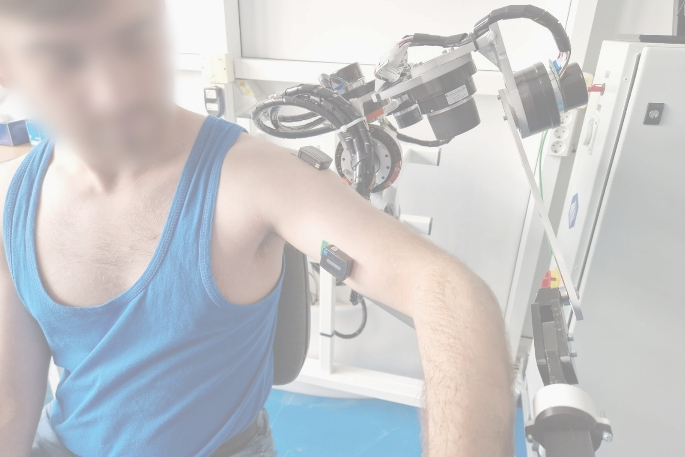
An assistive upper-body robotic exoskeleton system enhanced with non-immersive virtual reality and artificial intelligence to support early cardiac rehabilitation following open heart surgery. The system features 12 degrees of freedom and aims to improve patient recovery, quality of life, and rehabilitation accessibility.
Project Overview
Cardiac rehabilitation involves delivery of structured exercise, education and risk reduction in a cost-effective manner. Robust evidence demonstrates it reduces mortality up to 25%, improves functional capacity, and decreases re-hospitalization. However, following cardiac surgery, patients often experience difficulties with the rehabilitation process, finding it challenging and lacking motivation for rehabilitation activities.
With the global population aged 65 and over projected to rise by 207 percent by 2050, the need for cardiac rehabilitation will significantly increase. Traditional cardiac rehabilitation programs are grossly under-used worldwide, with only 38.8% of countries globally having CR programs available. To address these challenges, the CardioVR-ReTone project aims to provide motor recovery for patients following cardiac surgery or a major cardiac event, enabling them to live normal, active, and independent lives through an innovative robotic solution enhanced with virtual reality technology.
Partners & Acknowledgments
Technical University of Cluj-Napoca
Department of Manufacturing Engineering
Bdul. Muncii nr. 103-105
Cluj-Napoca, Romania
Iuliu Hațieganu University of Medicine and Pharmacy
Department of Internal Medicine,
Cardiology and Gastroenterology
Cluj-Napoca, Romania
Clinical Partners
Emergency Clinical Hospital
Cluj-Napoca
Cardiac Surgery Department
This work was supported by the Romanian National Authority for Scientific Research and Innovation, UEFISCDI, under project number PN-III-P2-2.1-PED-2019-1057 (Contract 535PED/2020). The project was part of the National Plan for Research, Development and Innovation 2015-2020.
Project Objectives
- Design and manufacture the prototype of robotic exoskeleton system – To create the CardioVR-ReTone exoskeleton with 12 degrees of freedom (6 DoFs on each arm) featuring a symmetric structure for upper limbs, enabling natural shoulder and elbow movements essential for cardiac rehabilitation exercises.
- Design and development of VR module – To develop non-immersive virtual reality exergame functionalities that interface with user requests and actions triggered from the robotic exoskeleton, providing engaging and motivating rehabilitation experiences.
- Integrate all components of CardioVR-ReTone system – To successfully integrate the Upper Body Robotic Exoskeleton with the Non-Immersive Virtual Reality Exergame system, creating a cohesive rehabilitation platform.
- Demonstration of concept validity and testing – To validate the CardioVR-ReTone prototype functionalities in research laboratories and clinical environments, achieving Technology Readiness Level 4 (TRL4) through comprehensive testing with cardiac surgery patients.
- Dissemination of results – To publish findings in high-impact journals, present at international conferences, and share results with the broader scientific community to advance the field of robotic-assisted cardiac rehabilitation.
Results & Outcomes
The CardioVR-ReTone project successfully developed a novel robotic exoskeleton concept with 12 degrees of freedom featuring a symmetric structure designed specifically for early rehabilitation of cardiac patients after open-heart surgery. The system integrates electromechanical design (geometric, kinematic, and dynamic models), control architecture, and VR-based operating modules.
The prototype was completed and underwent initial laboratory testing, followed by volunteer testing with iterative refinements based on feedback. The exoskeleton’s design allows for natural movements including shoulder raising/lowering, protraction/retraction, abduction/adduction, flexion/extension, and elbow movements, all within a medically validated cardiac rehabilitation protocol.
Key Achievements
- Successfully designed and manufactured a functional prototype with adjustable frame accommodating various patient sizes
- Developed comprehensive kinematic and dynamic models solving high complexity challenges through iterative algorithms
- Created non-immersive VR exergames including ball manipulation, robot arm control, door opening, and android control activities
- Validated concept through randomized controlled trial protocol with cardiac surgery patients
- Achieved Technology Readiness Level 4 (TRL4) through laboratory and clinical validation
Clinical Impact
The system enables early cardiac rehabilitation starting from day 2 after surgery, significantly earlier than traditional protocols which typically wait 6 weeks for upper-body training. Primary outcomes measured include quality of life modifications, with secondary outcomes encompassing sternal stability, muscular activity (EMG signals), cardiac response to exercise, and pain levels. The approach aims to improve patient motivation and adherence to rehabilitation programs through engaging VR-based exercises.
The gallery showcases the CardioVR-ReTone exoskeleton design, technical components, VR interface, and clinical application.
Publications & Outputs
Journal Articles
Mocan, B., Schonstein, C., Neamtu, C., Murar, M., Fulea, M., Comes, R., & Mocan, M. (2022). CardioVR-ReTone—Robotic Exoskeleton for Upper Limb Rehabilitation following Open Heart Surgery: Design, Modelling, and Control. Symmetry, 14(1), 81. https://doi.org/10.3390/sym14010081
Mocan, M., Vlaicu, S. I., Farcaș, A. D., Feier, H., Dragan, S., & Mocan, B. (2021). Cardiac Rehabilitation Early after Sternotomy Using New Assistive VR-Enhanced Robotic Exoskeleton—Study Protocol for a Randomised Controlled Trial. International Journal of Environmental Research and Public Health, 18(22), 11922. https://doi.org/10.3390/ijerph182211922
Impact & Future Applications
The CardioVR-ReTone system has the potential to transform cardiac rehabilitation delivery by enabling early intervention immediately following surgery, rather than waiting weeks for traditional protocols to begin. This approach could significantly improve patient outcomes, reduce re-hospitalization rates, and enhance quality of life for cardiac surgery patients. The system addresses critical challenges in CR availability and accessibility, particularly important given the aging global population.
Future research directions include scaling the system for broader clinical deployment, exploring home-based rehabilitation applications, and extending the technology to other rehabilitation contexts beyond cardiac care. The integration of VR-based exergaming demonstrates promising potential for improving patient motivation and adherence, which has historically been a major challenge in rehabilitation programs. The system’s modular design allows for adaptation to different patient needs and rehabilitation protocols, suggesting strong potential for technology transfer and commercialization opportunities in the medical device sector.
Last updated: January 2025 | For more information: CardioVR-ReTone Project Website